
The Kodiak Dispatch
July 2026 Edition

Welcome to the Kodiak Dispatch: a monthly newsletter for the acquisition entrepreneurship and independent sponsor community.
Read on below for updates on the latest happenings at Kodiak and spotlights on the business builders and ecosystem partners that make this space tick. This month, we examine the defining industrial story of the decade: the buildout of American energy infrastructure, and the opportunity it could create in the lower middle market.
The Energy Infrastructure Opportunity
After two decades of flat demand, America needs more power than it can currently generate, move, or maintain.
For roughly twenty years, U.S. electricity demand barely moved. Efficiency gains offset population and economic growth, utilities under-invested in new capacity, and the industrial base that builds and maintains the grid quietly atrophied. That era is over.
A few structural facts frame the current moment:
• Demand is inflecting after two flat decades. The EIA projects U.S. electricity consumption to set record highs in both 2025 and 2026, marking the first four consecutive years of demand growth since 2007 and the strongest four-year stretch since 2000, with growth expected to accelerate to 3% in 2027.
• AI and data centers are the marginal buyer of power. Goldman Sachs Research projects U.S. data center power demand to more than double from 31 GW in 2025 to 66 GW in 2027, lifting data centers’ share of peak summer demand from ~4% to ~8.5% in just two years. EPRI estimates data centers could consume between 9% and 17% of all U.S. electricity by 2030.
• Generation cannot keep up. Order backlogs at the three OEMs that produce more than two-thirds of the world’s gas turbines now stretch past 2029, with average lead times around five years and prices up ~75% for units delivering in 2030-2031. Developers are responding with behind-the-meter and distributed solutions, including fleets of industrial gensets pressed from backup duty into primary power.
• The equipment moving that power is old, and scarce. Much of the U.S. grid was built in the 1960s and 70s, and over half of the country’s transformers are 33+ years old against a ~40-year design life. Transformer lead times have stretched from under a year pre-pandemic to two-to-four years, prices are up 60–80% since 2020, and roughly 80% of large power transformers are imported.
• A capital supercycle appears to be underway to fix it. Investor-owned utilities are projected to invest $1.4T through 2030, following a record ~$204B of capex in 2025 (a 14th consecutive record year) and a projected 17% jump to ~$239B in 2026. Utility capital expenditures now outpace every other sector of the U.S. economy, according to the Edison Electric Institute.
• Skilled labor is the other bottleneck. Nearly 30% of union electricians are at or near retirement age and the BLS projects ~81,000 electrician openings per year through the decade, while the specialized workforce that builds transformers and turbines is aging even faster.
In our view, the prime beneficiaries in public markets (turbine OEMs, transformer manufacturers, electrical distributors) have already re-rated. But the buildout does not stop at the OEM loading dock. It runs through thousands of small, founder-owned businesses that fabricate, install, service, and maintain the physical layer of the grid. Within the category, a few segments stand out for acquisition entrepreneurs:
• Specialty fabrication and manufacturing. Regional fabricators producing enclosures, casings, structural steel, and components for transformer and switchgear OEMs. Qualification cycles, ISO certifications, and decade-long vendor relationships create real switching costs, and OEMs racing to expand domestic capacity are pushing more work to proven suppliers.
• Power and electrical services. Testing, commissioning, repair, and maintenance of substations, transformers, switchgear, and industrial electrical systems. Given replacement transformers generally take three years to arrive, the economics of maintaining and refurbishing the installed base improve dramatically.
• Distributed and backup generation. Sales, rental, integration, and service of generators and power-quality equipment. As utilities struggle to serve new load, on-site power has shifted from insurance policy to enabling infrastructure for data centers, healthcare, and industrial customers.
• Grid-adjacent MRO and consumables. The unglamorous products and services every energy project consumes (galvanizing, coatings, connectors, site services) where demand scales with total construction activity rather than with any single technology winning.
These businesses look a lot like the domestic manufacturers we profiled in our May edition: founder-led, decades old, and mission-critical to customers while representing a small share of total project cost, allowing them to maintain pricing power. Many owners are at or past retirement age, creating the same generational ownership transition we see across the industrial economy, at entry valuations that remain sensible relative to the durability of the demand behind them.
An example investment in the Kodiak portfolio is Fabtek Industries[1], a steel fabrication and manufacturing partner to the power generation sector. Read more about Fabtek in our Operator Spotlight below.
If you own, operate, advise, or are looking to acquire a business serving the power, utility, and energy infrastructure end markets, we’d love to hear from you.
Kodiak Operator Spotlight
Matt Bodnar | Fabtek Industries
A Goldman Sachs alum and veteran private equity sponsor who acquired Fabtek Industries, a Mississippi-based steel fabricator supplying the power generation and poultry processing sectors.
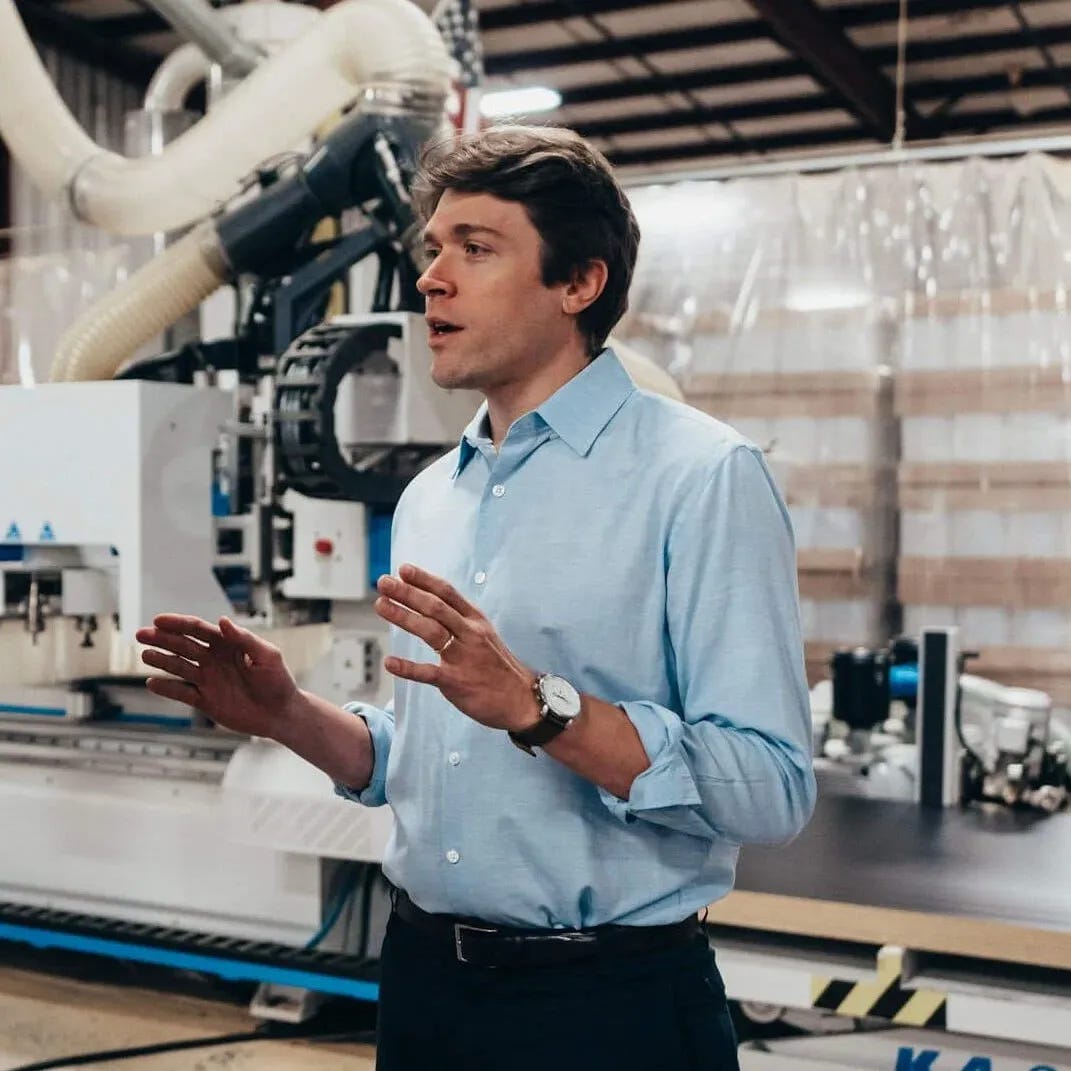
The Operator
Matt Bodnar is the Founder and Managing Partner of Eidolon Capital, a Nashville-based private investment firm that makes control investments in lower-middle-market companies. The firm typically partners with companies generating $10M to $100M in revenue and $3M to $10M in EBITDA across services, manufacturing, and distribution, with a long-term hold orientation.
Over nearly two decades, Matt has built his investment practice around an owner-operator philosophy: preserve what already works, invest in the people who built it, and grow patiently from a strong foundation. He serves as Chairman of Fabtek Industries, Ozark River Manufacturing, Tennessee Rack, and Fresh Technology.
Matt began his career on the interest rate desk at Goldman Sachs in the aftermath of the Great Financial Crisis and additionally spent time as a consultant in Nanjing, China. He was named to Forbes 30 Under 30 (2017) and is the creator and host of The Science of Success, a podcast on the psychology of achievement and evidence-based decision-making with more than 5 million downloads across 390+ episodes. Matt holds a B.A. from the University of Richmond in Political Science, Business, and Chinese.
The Business
Fabtek Industries is a steel fabrication and light manufacturing company based in Hazlehurst, Mississippi, operating from a 50,000-square-foot production facility with a multi-decade operating history. The business has two complementary revenue streams: (i) contracted production manufacturing of industrial electrical equipment (transformer casings, cabinets, frames, and pad-mount transformer assemblies) for blue-chip global power infrastructure OEMs; and (ii) industrial repair and maintenance services for high-volume poultry and food processing plants across the region. Capabilities span precision laser and water-jet cutting, CNC machining, press-brake forming, welding, powder coating, and transformer winding and assembly, all under ISO 9000 certification.
What Got Us Excited
Fabtek sits squarely at the intersection of two of the themes we are most excited about in industrials: the energy infrastructure buildout described above and the reshoring of critical manufacturing. Its OEM customers are racing to expand domestic transformer production against multi-year order backlogs, creating significant volume increases for Fabtek’s primary product lines. At the time of investment, Fabtek also had meaningful untapped capacity that could be unlocked through incremental shifts on key production lines and strategic investments in automation systems, both of which the company has since pursued.
The other half of the business is equally attractive for different reasons: recurring repair and maintenance work for poultry processors, where downtime costs are enormous and maintenance is non-deferrable, producing consistent, counter-cyclical demand. Customer relationships across both segments stretch back more than a decade, anchored by a reputation for reliable, high-quality work.
The Transaction
Matt and the Eidolon team were embedded with Fabtek’s management for months before signing, working on-site to digest and effectively pull forward much of the typical post-close value creation work. The transaction closed in late 2024 with continuity at its core: the founder remains as CEO while Matt serves as Chairman.
In the 18+ months since close, Fabtek has grown the business via existing customer expansion and net new sales momentum. The Company has made several operational investments to expand capacity, including a Voortman automation system, a 50,000 square foot facility expansion, and an ISO 9001:2015 certification which allows the business to compete for larger tier-1 OEM, utility, and EPC contracts. On the human capital side, Fabtek recently hired Colin Teaster as CFO and Ben Gilbert as Controller, and continues to build out systems, processes, HR, IT, and ERP capabilities to support growth.
Kodiak invested in the preferred equity syndicate backing the acquisition, alongside conventional senior debt and the seller’s rollover. Post investment, we’ve been working with Matt and the team around areas in which AI could help improve operational efficiency and sales momentum within the business, including an automated quoting engine given the amount of inbound demand the Company is seeing. We’re excited to support Matt and the Fabtek team as they scale with the grid buildout.
Ecosystem Spotlight
Burton Francis | ECA Partners
A former Boeing engineer and manufacturing CEO turned executive search leader whose practice has built a strong reputation for placing executives for search fund and independent sponsor-backed companies.

Background
Burt Francis is a Managing Director at ECA Partners, where he leads the firm’s Private Equity Value Creation Practice, partnering with investors and boards to recruit CEOs, Presidents, COOs, CFOs, and other senior executives for mid-market and lower-middle-market investor-backed businesses.
His path to executive search is decidedly operational: he began his career as an engineer at General Dynamics and Boeing, stepped in to run Starbase Technologies – his family’s precision manufacturing and injection mold-making business – as President and CEO and later Executive Chairman, and then joined Oliver Wyman as a strategy consultant focused on post-deal private equity value creation. He holds a B.S. and M.S. in Mechanical Engineering from Rensselaer Polytechnic Institute, summa cum laude.
A Practice Built for Searchers and Independent Sponsors
Since joining ECA seven years ago, Burt has built the firm’s private equity and ETA practice from scratch into a widely recognized practice in the search fund and independent sponsor ecosystem. ECA, an executive search firm founded in 2010, pairs an evidence-based, data-driven methodology with speed, filling searches much faster than traditional firms with a 96% success rate.
The lower-middle-market work Burt leads is aimed at the moment every acquirer eventually faces: professionalizing the leadership of a founder-owned or lifestyle business. That includes recruiting strong seconds and thirds (CFOs, COOs, CROs) post-acquisition as well as placing co-CEOs, Presidents and GMs alongside solo searchers who need an operating partner. Burt is a familiar presence in the community, working with many of the most active search fund investors and sponsoring independent sponsor events including the iGlobal Independent Sponsors Summit.
Why Leadership Is the Value Creation Lever
Fittingly for this month’s theme, much of Burt’s work sits in industrials and manufacturing, where he pairs a genuine operator’s understanding of the shop floor with institutional search rigor. In the lower middle market, the difference between an average outcome and a great one is almost always the team, and Burt has built a practice around exactly that insight. We’re proud to count Burt as part of the Kodiak ecosystem.
Get in touch: bfrancis@eca-partners.com
Disclaimer: This newsletter is provided for informational and background purposes only and is intended to describe the professional experience, leadership approach, and general investment philosophy of Kodiak Holdings Capital Management, LP and its leadership team. It is intended solely for operators being considered as potential investment partners of Kodiak and is not directed at, and should not be relied upon by, any person considering an investment in any Kodiak-affiliated fund or vehicle. It does not constitute an offer to sell or a solicitation of an offer to buy any securities or investment advisory services. The views expressed are general in nature and should not be relied upon as investment advice. Investment strategies and processes involve risk and do not guarantee future results.
[1] Fabtek is an illustrative example of a current Kodiak investment that reflects the thesis above and was selected in part on its strategic significance; it is not representative of the performance or outcomes of Kodiak investments.